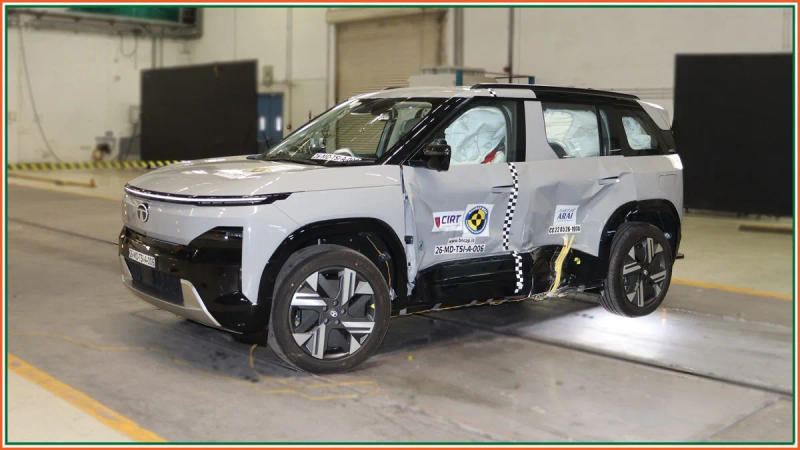
The Mahindra XEV 9S, the company's three-row electric SUV, has scored five stars in Bharat NCAP crash tests. Mahindra announced the result on 17 November 2026. The XEV 9S got 31.15 out of 32 for Adult Occupant Protection (AOP) and 45 out of 49 for Child Occupant Protection (COP). According to Mahindra, its combined 76.15 points are the highest any seven-seater has scored under India's crash-test programme so far, petrol, diesel or electric.
Mahindra says the XEV 9S is the first seven-seat electric vehicle in India to get a five-star Bharat NCAP rating. It is also the third model on the company's INGLO electric platform to get five stars, after the XEV 9e and BE 6.
XEV 9S Bharat NCAP scores at a glance
| Test | Score |
|---|
| Adult Occupant Protection (total) | 31.15 / 32 (5 stars) |
| Frontal offset deformable barrier | 15.15 / 16 |
| Side movable deformable barrier | 16 / 16 |
| Side pole impact | Good protection, all regions |
| Child Occupant Protection (total) | 45 / 49 (5 stars) |
| Child dynamic tests | 24 / 24 |
| Child seat installation | 12 / 12 |
| Vehicle-based assessment | 9 / 13 |
| Combined score | 76.15 / 81 |
How the test went
In the frontal offset crash, the dummy in the driver's seat showed good protection for the head, neck, chest, pelvis, thighs, lower legs and feet. The front passenger also got good protection for most of the body, but chest protection was rated adequate. That is the main reason the SUV fell 0.85 points short of the full 16 in this test.
The XEV 9S got full marks in the side barrier test, and the side pole test showed good protection for every body region measured.
For children, the SUV got the full 24 points in the dynamic tests, using dummies of an 18-month-old and a 3-year-old in both frontal and side impacts. It also got 12 out of 12 for child-seat installation. The 4 points it lost all came from the vehicle-based assessment, which looks at things such as child-safety features and warning labels rather than crash performance.
Which variants were tested?
Bharat NCAP crash-tested two versions: the six-seat Pack Two Above and the seven-seat Pack Three Above, both with the 79 kWh battery. The rating applies to all variants of the XEV 9S.
Equipment is not the same across the range, though. Six airbags, ESP, ISOFIX child-seat mounts and tyre-pressure monitoring are standard. Pack Three and Pack Three Above add a driver's knee airbag, for seven airbags in total. Mahindra's Level 2+ driver-assistance system, which uses five radars and a camera, is only on the higher trims. So is the driver drowsiness monitor.
How it compares with other seven-seaters
| Model | Adult (out of 32) | Child (out of 49) | Combined |
|---|
| Mahindra XEV 9S | 31.15 | 45.00 | 76.15 |
| Mahindra XUV 7XO | 30.76 | 44.97 | 75.73 |
| Tata Safari | 30.08 | 44.54 | 74.62 |
The lead is small: the XEV 9S beats its petrol and diesel sibling, the XUV 7XO, by 0.42 points. All three SUVs have five stars in both categories. For buyers, the result shows the electric seven-seater gives up nothing in crash safety compared with Mahindra's combustion-engine SUVs, even though it carries a heavy battery under the floor.
XEV 9S: key specifications
- Battery options: 59 kWh, 70 kWh and 79 kWh (LFP chemistry), and Mahindra offers a lifetime battery warranty
- Power: 170 kW (59 kWh), 180 kW (70 kWh), 210 kW (79 kWh), all with 380 Nm
- Performance: 0-100 km/h in 7.0 seconds, top speed 202 km/h
- Range: about 500 km real-world, according to Mahindra
- DC fast charging: 20 to 80 percent in about 20 minutes, on a charger of 140 kW, 160 kW or 180 kW depending on the battery
- Luggage space: up to 527 litres of boot space plus a 150-litre front trunk
Mahindra launched the XEV 9S in November 2025 with introductory prices from ₹19.95 lakh to ₹29.45 lakh (ex-showroom), and deliveries began in January 2026. Prices have changed since launch and vary by city, so check the current ex-showroom price with a dealer. Mahindra says the XEV 9S was India's best-selling electric passenger vehicle by wholesale volume in April-September 2026.
What it means for buyers
Families shopping for an electric three-row SUV now have an official, independent safety score to go on. The child protection result matters most here, because many seven-seater buyers will carry children in the second and third rows. Keep in mind that Bharat NCAP does not rate the third row separately.
The rating covers every variant, so even the entry Pack One Above has the same crash-tested body. If active safety matters to you, such as adaptive cruise, automatic emergency braking and the seventh airbag, look at Pack Two Above or higher.
Rivals
The XEV 9S has few direct electric rivals with three rows of seats at this price. Buyers are likely to compare it with five-seat electric SUVs such as the Tata Harrier.ev and the Mahindra XEV 9e, which both have five-star Bharat NCAP ratings, or with combustion seven-seaters such as the XUV 7XO and Tata Safari. Among seven-seaters of any fuel type, the XEV 9S now has the highest Bharat NCAP score.