Indian Automakers Set Sights on UK EV Market Through India-UK Free Trade Agreement
Quick Summary
Enjoyed this article?
Advertisement
Indian passenger vehicle manufacturers are preparing to explore new growth opportunities in the United Kingdom's electric vehicle market following the India-UK Free Trade Agreement (FTA).
Leading automakers such as Maruti Suzuki, Mahindra & Mahindra (M&M), and Tata Motors Passenger Vehicles see the agreement as a major step toward expanding exports and strengthening India's position as a global EV manufacturing hub.
Duty-Free EV Exports to Begin Under Quota System
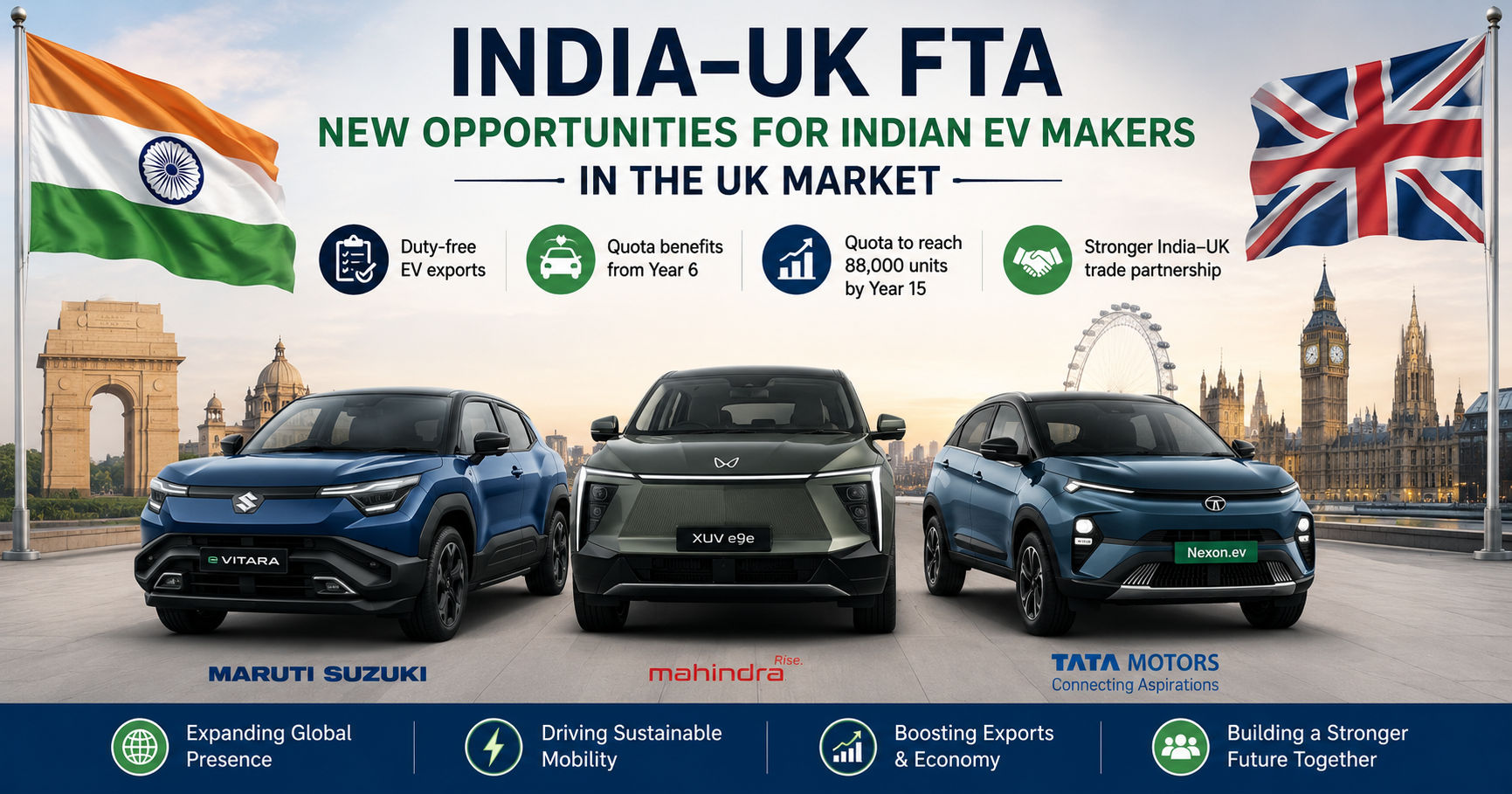
Under the agreement, India will gain duty-free access for electric, hybrid, and hydrogen-powered passenger vehicles exported to the UK through a phased quota system.
The benefits will begin from the sixth year after implementation and cover vehicles priced between under GBP 20,000 and GBP 80,000.
The quota allocation will gradually increase and reach 88,000 vehicles annually by the 15th year, remaining at that level in subsequent years.
However, vehicles priced above GBP 80,000 will not receive duty concessions.
Automakers See Global Expansion Opportunities
Mahindra & Mahindra stated that the UK remains an attractive market because it is a right-hand-drive country, aligning with India's vehicle manufacturing ecosystem.
The company said it will carefully evaluate market opportunities as part of its global expansion strategy for electric SUVs.
Maruti Suzuki also welcomed the agreement, highlighting its existing export momentum through the eVITARA electric SUV, which is already being shipped to European markets, including the UK.
Tata Motors described the agreement as a positive development that could accelerate sustainable mobility while creating long-term export opportunities for Indian-made electric vehicles.
Annual Quotas Will Increase Gradually
In the sixth year, India will receive a total quota of 17,600 vehicles, distributed across different price categories.
By the 15th year, the quota will expand to 88,000 vehicles annually, supporting larger export volumes for Indian manufacturers.
Boost for 'Make in India'
The agreement supports India's ambition of becoming a global automotive manufacturing and export hub.
Industry experts believe the FTA will strengthen India's EV ecosystem, encourage investments, and improve the competitiveness of Indian-made electric vehicles in international markets.
The India-UK trade pact is also expected to significantly increase bilateral trade between both nations over the coming years.
FAQs
1. What is the India-UK FTA for electric vehicles?
It is a trade agreement that allows India to export certain electric, hybrid, and hydrogen passenger vehicles to the UK with reduced or zero customs duties under a quota system.
2. Which Indian automakers may benefit from the agreement?
Companies such as Maruti Suzuki, Mahindra & Mahindra, and Tata Motors are expected to benefit from new export opportunities.
3. When will duty-free exports begin?
The duty-free export benefits for passenger EVs will start from the sixth year of the agreement.
4. How many vehicles can India export under the quota system?
The quota will gradually increase and reach 88,000 vehicles annually from the 15th year onward.
5. Which vehicles are eligible?
Electric, hybrid, and hydrogen-powered passenger vehicles priced below GBP 80,000 are eligible.
6. Are luxury vehicles included?
No. Vehicles priced above GBP 80,000 are excluded from duty concessions.
7. Why is the UK important for Indian automakers?
The UK is a right-hand-drive market, making Indian-made vehicles more suitable for export without major modifications.
8. How does this benefit India's EV industry?
It opens international markets, boosts manufacturing, supports exports, and strengthens India's position as a global EV hub.
Advertisement
Found this helpful?
Share with your friends & EV community