Tata Harrier EV Buyer's Guide 2026: 65 vs 75 kWh, RWD vs QWD, Which Variant to Buy and Real-World Range
7 min
EV news, prices & data for India
The Honda Activa e: can't be charged at home; it runs on swappable batteries. Here's how swapping and the subscription plans work, prices of both variants, range, running cost, warranty and who should buy it.
Advertisement
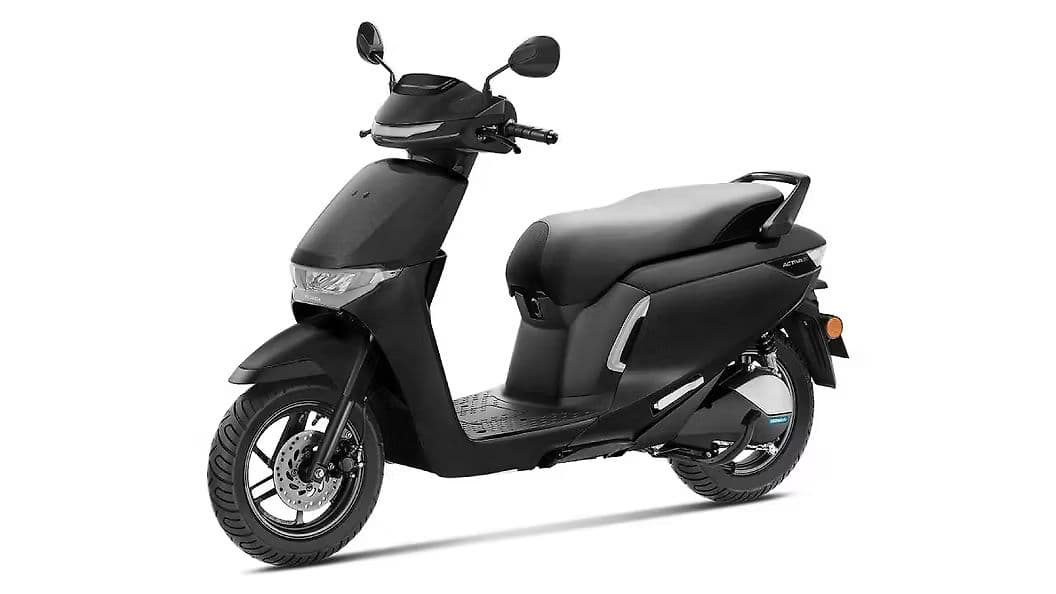
The Honda Activa e: carries India's best-known scooter name, but it works very differently from the petrol Activa and from most electric scooters. It has no charging port. Instead, it runs on two swappable 1.5 kWh batteries that you exchange for charged ones at Honda e: Swap stations. That makes it brilliant for some riders and impractical for others. This guide explains how swapping works, what it costs, which variant to buy, and whether the Activa e: suits you.
| Variant | Battery | Claimed range (IDC) | Ex-showroom |
|---|---|---|---|
| Activa e: Standard | 3 kWh (2 × 1.5 kWh swappable) | 102 km | ₹1,20,133 |
| Activa e: RoadSync Duo | 3 kWh (2 × 1.5 kWh swappable) | 102 km | ₹1,52,441 |
Ex-showroom prices verified in November 2026. Battery swapping is paid separately through a subscription. The PM E-Drive incentive for electric two-wheelers applies until March 2028; ask your dealer how it's reflected in your price.
On-road prices: Delhi, Mumbai, Bangalore. Full specifications: Honda Activa e: page.
Mechanically, the two variants are identical: the same 6 kW (peak) swingarm-mounted motor with 22 Nm, a claimed 0–60 km/h time of 7.3 seconds, an 80 km/h top speed and the same 102 km claimed range. The difference is the dashboard and connectivity:
The RoadSync Duo costs ₹32,308 more. That's a lot for a screen and navigation, especially when you can mount your phone. Unless built-in navigation really matters to you, the Standard is the better buy.
But the bigger question is not which variant, it's whether the Activa e: works where you live, which depends entirely on swap station coverage.
Honda claims 102 km (IDC) from the two packs. BikeIndia notes that this figure is achievable only in the Econ riding mode. The scooter also has Standard and Sport modes, which use more energy. We haven't found an independent, named full range test of the Activa e:, so we can't give you a tested number. IDC is a gentle, low-speed test, so plan on clearly less than 102 km in daily riding, especially with a pillion, in Sport mode or in heavy traffic.
With swapping, though, range matters less than it does on other scooters. When the packs run low, you swap them for fully charged ones rather than waiting hours to charge, provided there's a station on your route.
The Activa e: cannot be charged at home. There's no charging port and no home charger. Here's how it works instead:
The catch is coverage. Honda launched the Activa e: and its swap network in Bengaluru, Delhi and Mumbai, and at launch said it planned over 250 stations in Bengaluru by 2026. If you live elsewhere, or there's no station near your home, office and regular routes, the scooter is simply not practical. Before booking, check the station map in Honda's app and make sure you have at least two stations within easy reach, in case one runs out of charged packs. For comparison, conventional electric scooters charge from a home socket; our EV charging guide explains how that works.
Because the Activa e: can't be charged at home, the usual ₹8 per kWh home-charging figure doesn't apply. First, the efficiency: 3 kWh ÷ 102 km = 0.029 kWh per km at the claimed range. If you could charge it at home at ₹8 per kWh, that would work out to about ₹0.24 per km, but that isn't an option.
Instead, you pay through swap plans. In June 2025, Autocar India reported these monthly plans, with Honda billing on total energy used in the month:
| Plan | Monthly price | Energy included | Max km at claimed efficiency | Cost per km (estimate) |
|---|---|---|---|---|
| Lite | ₹678 | 20 kWh | 20 ÷ 0.029 ≈ 680 km | ≈ ₹1.00 |
| Basic | ₹1,999 | 35 kWh | 35 ÷ 0.029 ≈ 1,190 km | ≈ ₹1.68 |
| Advanced | ₹3,999 | 87 kWh | 87 ÷ 0.029 ≈ 2,958 km | ≈ ₹1.35 |
These are best-case estimates: real-world efficiency is worse than the claim, so you'll cover fewer km per plan and the cost per km will be higher. Also confirm whether GST is extra and what happens if you use more energy than your plan includes. Even so, riding an Activa e: is likely to cost less per km than a petrol scooter, but more than a scooter you can charge at home. Our EV savings calculator can help you compare.
The Activa e: gets a front disc brake with a combined braking system (CBS); ABS isn't offered. Other features include Honda Smart Key, 12-inch alloy wheels with tubeless tyres and 171 mm of ground clearance. At 118 kg (Standard) and 119 kg (RoadSync Duo), it's easy to handle in traffic.
Because you swap packs at stations, ask your dealer how the battery warranty and pack replacement work under your subscription.
We found no recall for the Activa e:. Its limitations come from the swapping design rather than faults:
If you can charge at home, most rivals offer more range and lower running costs. The TVS iQube is the most obvious alternative; see our Activa e: vs iQube comparison. Also consider the Suzuki e Access, Bajaj Chetak 35 Series and Ather Rizta.
The Honda Activa e: is a well-built scooter with Honda's reputation behind it, and battery swapping gives you a "refuelling" experience that takes about a minute. But it suits only riders who live and work near several Honda e: Swap stations and who can't charge at home, such as apartment dwellers without a parking-area socket. For them, the Activa e: Standard at ₹1,20,133 is the one to buy. Everyone else will get more range and lower running costs from a conventional electric scooter they can plug in at home.
Image: Honda Motorcycle & Scooter India
No. The Activa e: has no charging port and Honda doesn't offer a home charger. Its two 1.5 kWh Honda Mobile Power Pack e: batteries can only be recharged by swapping them for charged packs at Honda e: Swap stations, which takes about a minute. Check swap station coverage near your home and workplace before buying.
In November 2026, the Activa e: Standard costs ₹1,20,133 and the Activa e: RoadSync Duo costs ₹1,52,441 ex-showroom. Battery swapping is paid separately, through a monthly plan. The PM E-Drive incentive for electric two-wheelers applies until March 2028.
In June 2025, Autocar India reported three monthly plans: Lite at ₹678 (20 kWh of energy), Basic at ₹1,999 (35 kWh) and Advanced at ₹3,999 (87 kWh). Honda bills on total energy used in the month. Plans and GST treatment may have changed since, so confirm current rates with Honda.
Honda claims 102 km (IDC) from the two packs, and BikeIndia notes that figure is achievable only in the Econ riding mode. We haven't found an independent, named full range test, so we can't give a tested figure. Expect less in the Standard and Sport modes.
Both have the same 3 kWh swappable batteries, 6 kW motor, 80 km/h top speed and 102 km claimed range. The RoadSync Duo, at ₹32,308 more, adds a large 7-inch colour TFT display with smartphone connectivity, notification alerts and turn-by-turn navigation through Honda's app, which the Standard doesn't get.
Honda lists a 3-year / 50,000 km warranty for the vehicle and battery, 3 years for the motor, and 3 years of roadside assistance.
Advertisement