

Tata Harrier EV Buyer's Guide 2026: 65 vs 75 kWh, RWD vs QWD, Which Variant to Buy and Real-World Range
7 min
EV news, prices & data for India
TVS iQube is India's best-selling electric scooter brand, but with six versions from 2.3 kWh to 5.3 kWh, choosing is confusing. Here's every variant with price, range, charging time and our pick for different riders.
Advertisement
TVS was India's No. 1 electric two-wheeler maker in October 2026, selling a record 60,429 units (27% market share), and the iQube is the scooter behind most of those sales. It's a comfortable, well-built family scooter backed by TVS's network of over 3,300 dealers. The tricky part is choosing a version: there are six, from a 2.3 kWh city scooter to a 5.3 kWh long-ranger.
| Variant | Battery | IDC range | Top speed | Ex-showroom (Bengaluru) |
|---|---|---|---|---|
| iQube 2.3 | 2.3 kWh | 114 km | 68 km/h | ~₹1.20 lakh |
| iQube 3.1 | 3.1 kWh | 123 km | 82 km/h | ~₹1.35 lakh |
| iQube 3.5 | 3.5 kWh | 145 km | 82 km/h | ~₹1.45 lakh |
| iQube MillionR Edition | 3.5 kWh | 145 km | 82 km/h | ~₹1.49 lakh |
| iQube S 4.7 | 4.7 kWh | 175 km | 82 km/h | ~₹1.65 lakh |
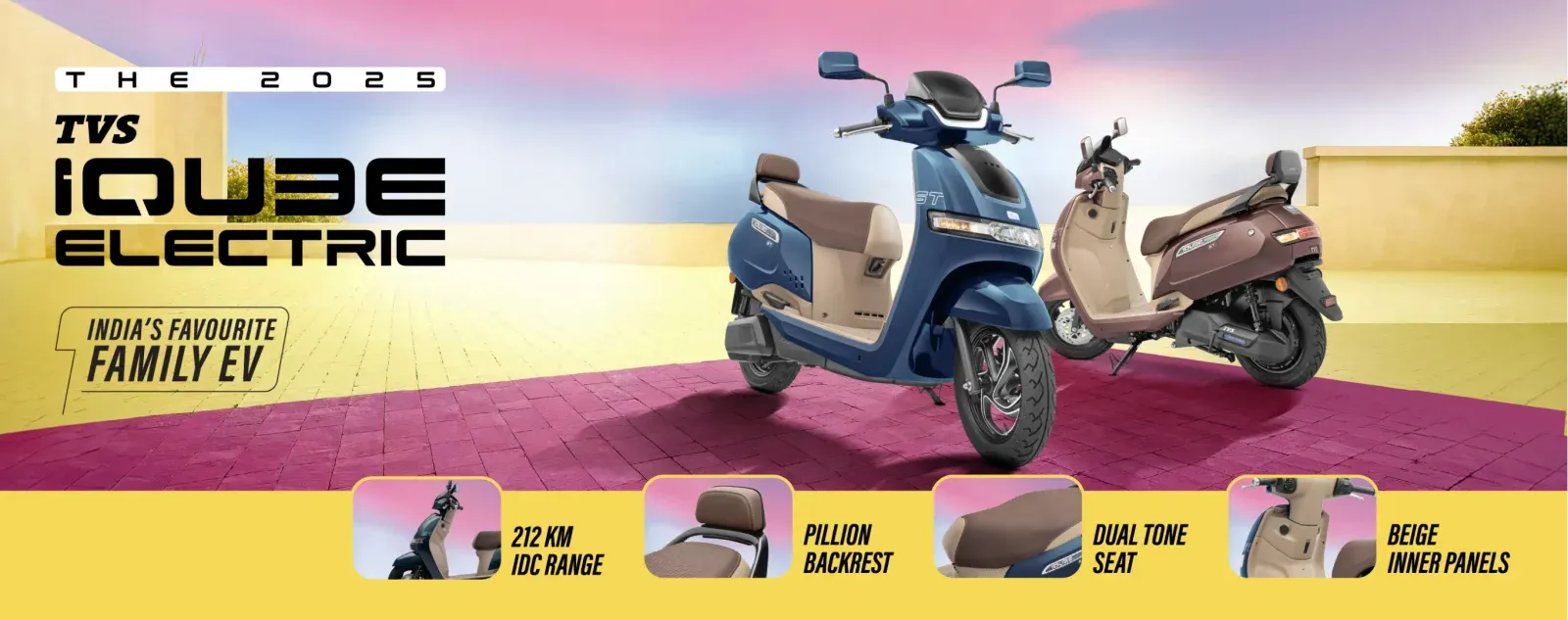
| iQube ST 5.3 | 5.3 kWh | 212 km | 82 km/h | ~₹1.75 lakh |
Ex-showroom Bengaluru prices from Autocar India (updated 3 November 2026). TVS's website shows lower 'starting from' figures that appear to be effective or offer prices. Prices vary by state, so always confirm the on-road price with your dealer.
What changed in 2026: the iQube S 4.7 kWh arrived in May (replacing the S 3.5), and in August the base 2.2 kWh was replaced by a 2.3 kWh version with a smaller 3.68 kW motor, drum brakes and an LCD screen.
Full specs: TVS iQube page. On-road prices: Bangalore, Chennai, Delhi, Hyderabad.
Our pick: the iQube 3.1 for most commuters, and the S 4.7 if you ride long distances daily. Autocar India makes the same recommendation.
We haven't found independent road tests of the newest 2.3, S 4.7 and ST 5.3 battery packs yet. Tests of earlier versions give a useful guide:
As a rule of thumb, expect roughly 70–80% of the IDC figure in Eco mode, and much less if you ride in Power mode.
The iQube comes with a portable charger that plugs into a regular 15A socket. TVS's claimed 10–80% times:
Autocar India's measured 0–80% times were somewhat longer. Unlike Ather, TVS doesn't have its own fast-charging network, so the iQube is best for riders who can charge at home or work.
Electric scooters like the iQube typically cost around ₹0.25–0.30 per km to charge at a home tariff of ₹8 per unit. A petrol scooter costs about ₹2.2 per km at 45 km/l and ₹100/litre. At 1,000 km a month, that's a saving of roughly ₹1,900 a month. Calculate yours with our EV savings calculator.
TVS SmartXonnect has a free Basic plan. The Advanced plan, with live tracking, nearby chargers and private mode, is free for the first year and then needs a paid annual subscription.
Reviewers have pointed out a shallow boot on the base model, Park Assist cutting the motor unexpectedly, a charger that doesn't lock in, a soft seat, display flicker under regen and slow throttle response in Eco mode.
Compare the iQube with the Ather Rizta, Bajaj Chetak, Honda Activa e and Hero Vida VX2.
The iQube is a dependable, comfortable family scooter backed by a huge dealer network. The 3.1 kWh is the sweet spot for most people. Step up to the S 4.7 for fewer charging stops, and only pick the 2.3 if your rides are short and slow.
Image: TVS Motor Company
For most city riders doing around 40–50 km a day, the iQube 3.1 kWh or 3.5 kWh offers the best balance of price, range and an 82 km/h top speed, as Autocar India also recommends. Choose the S 4.7 or ST 5.3 if you want to charge less often. The base 2.3 kWh is only for short, slow city trips because of its 68 km/h top speed and drum brakes.
Ex-showroom Bengaluru prices (Autocar India, November 2026) range from about ₹1.20 lakh for the 2.3 kWh to about ₹1.75 lakh for the ST 5.3 kWh. TVS's website shows lower 'starting from' prices, so check the final on-road price with your dealer.
IDC ranges are 114 km (2.3 kWh), 123 km (3.1 kWh), 145 km (3.5 kWh), 175 km (S 4.7 kWh) and 212 km (ST 5.3 kWh). Real-world range is lower. Earlier road tests found roughly 75–80% of the claimed figure in Eco mode, and less in Power mode.
On TVS's 950 W portable charger, 10–80% takes about 2 hours 25 minutes (2.3 kWh), 3 hours 30 minutes (3.1 kWh), 3 hours 45 minutes (3.5 kWh), 3 hours 15 minutes (S 4.7) and 4 hours (ST 5.3), according to TVS. Autocar India's measured 0–80% times are a little longer.
TVS lists a 3-year warranty on the vehicle and a 3-year / 50,000 km warranty on the battery.
In June 2024, TVS ran a voluntary recall to inspect the chassis bridge tube on iQubes made between 10 July and 9 September 2023, with free repair or replacement. We found no recall for current models.
Advertisement

