BYD Rolls Out 150,000th Commercial Electric Vehicle
Quick Summary
BYD has reached 150,000 commercial plug-in vehicles produced globally, highlighting the growing scale of heavy-duty electric transport.
India's #1 Electric Vehicle Platform
Quick Summary
BYD has reached 150,000 commercial plug-in vehicles produced globally, highlighting the growing scale of heavy-duty electric transport.
EV Radar News Desk
EV Radar
Enjoyed this article?
Advertisement
BYD has assembled its 150,000th commercial plug-in vehicle, crossing a major manufacturing threshold for its commercial vehicle division. While passenger models like the Atto 3, Seal, and eMax 7 capture consumer headlines, the Shenzhen-based manufacturer has spent over a decade building battery-electric public transit buses, logistics vans, terminal tractors, and heavy vocational trucks.
Building 1.5 lakh commercial EVs is a different ballgame than building passenger cars. Commercial vehicles face punishing duty cycles, higher battery capacities often exceeding 300 kWh, and long operating hours without downtime. BYD began testing electric buses as far back as 2010, initially deploying them in Chinese municipal fleets before shipping chassis and fully built units to markets across Europe, Japan, Latin America, and India.
In India, BYD's initial automotive entry did not happen through retail car showrooms. Instead, it arrived through the public bus sector. BYD partnered with Hyderabad-based Olectra Greentech nearly a decade ago, supplying electric bus chassis, motors, and lithium iron phosphate (LFP) battery packs for assembly in India. Models like the K7 and K9 e-buses were among the first zero-emission public transport vehicles deployed by state transport undertakings, including BEST in Mumbai, TSRTC in Telangana, and BMTC in Bengaluru.
Those early commercial deployments proved that electric buses could handle severe Indian operating conditions: intense summer heat, waterlogged roads during monsoons, and passenger overloads. While BYD later shifted its domestic strategy to focus heavily on direct passenger vehicle sales, its commercial vehicle hardware continues to log lakhs of passenger kilometres daily on Indian streets.
For Indian fleet managers, BYD hitting 150,000 commercial units signals that heavy-duty electrification has moved past the pilot phase into industrial maturity. Medium and heavy commercial vehicles account for a tiny percentage of vehicles on Indian roads but consume a disproportionate share of diesel. That makes fleet transition the fastest path to cutting corporate fuel expenditure.
Commercial fleet buyers evaluate total cost of ownership over seven to ten years rather than sticker price alone. BYD's massive production volume offers three clear indicators for the wider industry:
Despite BYD's global scale, the Indian commercial vehicle market remains largely closed to direct Chinese imports. Strict localisation rules under subsidies like the PM-eBus Sewa and the PM E-DRIVE scheme, combined with Press Note 3 FDI restrictions, mean Indian transport authorities and fleet buyers source their vehicles locally.
Homegrown manufacturers currently lead the Indian commercial EV race. Tata Motors holds substantial orders for electric city buses across major metros. Switch Mobility, the electric arm of Ashok Leyland, is expanding deliveries of its low-floor urban buses and light commercial vehicles. JBM Auto and Olectra Greentech also run extensive order books for intercity and urban municipal fleets. On the light goods side, Tata's Ace EV and Mahindra's electric load carriers dominate last-mile logistics.
The next frontier for commercial plug-in platforms is long-haul logistics. While city buses and 1-tonne urban delivery vans make economic sense today, 40-tonne tractor-trailers face battery weight penalties and a lack of megawatt-level highway charging stations. BYD and its global peers are deploying heavy electric trucks for short-haul port drayage and mining operations, where trucks return to a central depot every shift. Indian fleet operators looking at container movements between ports and inland container depots will likely see the first wave of heavy electric tractor deployments follow that exact pattern.
Source: CleanTechnica
Advertisement
The milestone covers commercial plug-in vehicles including battery-electric city buses, logistics vans, vocational sweepers, terminal yard tractors, and heavy trucks.
BYD previously partnered with Olectra Greentech to supply electric bus chassis and batteries for Indian municipal fleets, though its current direct Indian retail line-up centres on passenger cars like the Atto 3, Seal, and eMax 7.
Domestic manufacturers including Tata Motors, Ashok Leyland's Switch Mobility, Olectra Greentech, and JBM Auto dominate electric bus and commercial vehicle tenders in India.
Found this helpful?
Share with your friends & EV community
Volvo's flagship electric SUV arrives as a fully loaded six-seater, undercutting the Kia EV9 and Mercedes EQS SUV. Deliveries begin January 2027.

Demand for electric and CNG vehicles is pushing delivery timelines higher ahead of India's festive season, with some EVs facing waits of up to four months and the TVS iQube extending to as much as five months.
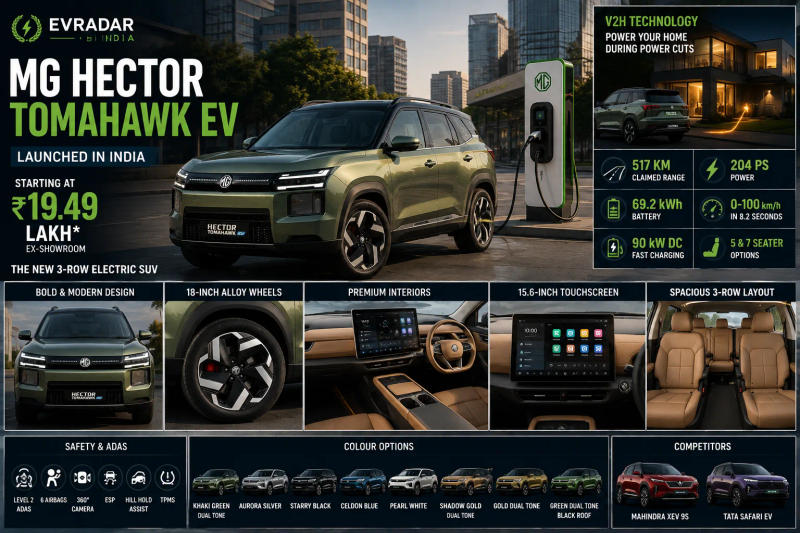
MG Hector Tomahawk EV launched in India at ₹19.49 lakh with a 69.2 kWh battery, 517 km claimed range, 204 PS and V2H technology.

India's EV market is set for another wave of new launches, with the Tata Safari EV, Maruti YMC, Hyundai HE1i, Tata Tigor EV facelift and Mahindra BE.07 among the electric models expected to arrive by 2027.

India's electric vehicle market crossed 25 lakh registrations in FY2025-26, highlighting the rapid expansion of electric two-wheelers, cars and three-wheelers as EV adoption reaches a new milestone.
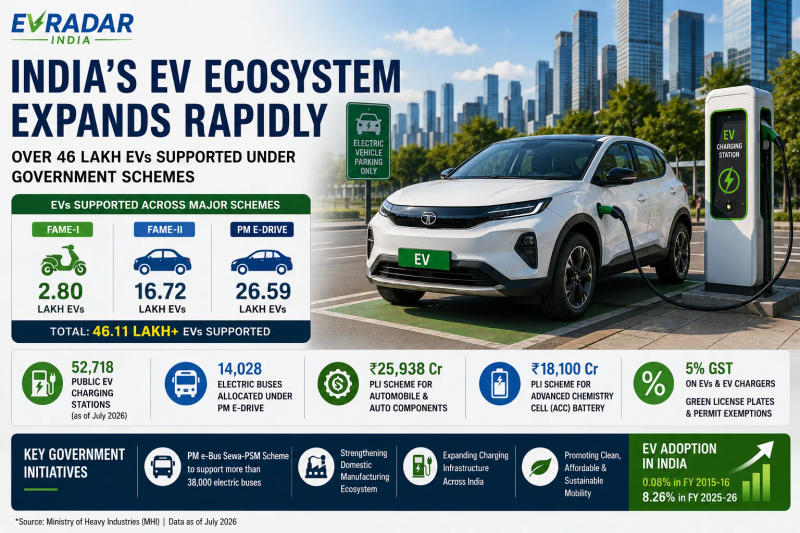
More than 46 lakh EVs have been supported under major government schemes as India expands charging infrastructure, electric buses, battery manufacturing and domestic electric mobility.
Written by
EV journalist at EV Radar — covering electric cars, bikes, and India's EV revolution.