Enjoyed this article?
Advertisement
India EV Sales Cross 25 Lakh in FY2025-26 as Electric Mobility Enters the Mainstream
India's transition toward electric mobility has reached another major milestone.
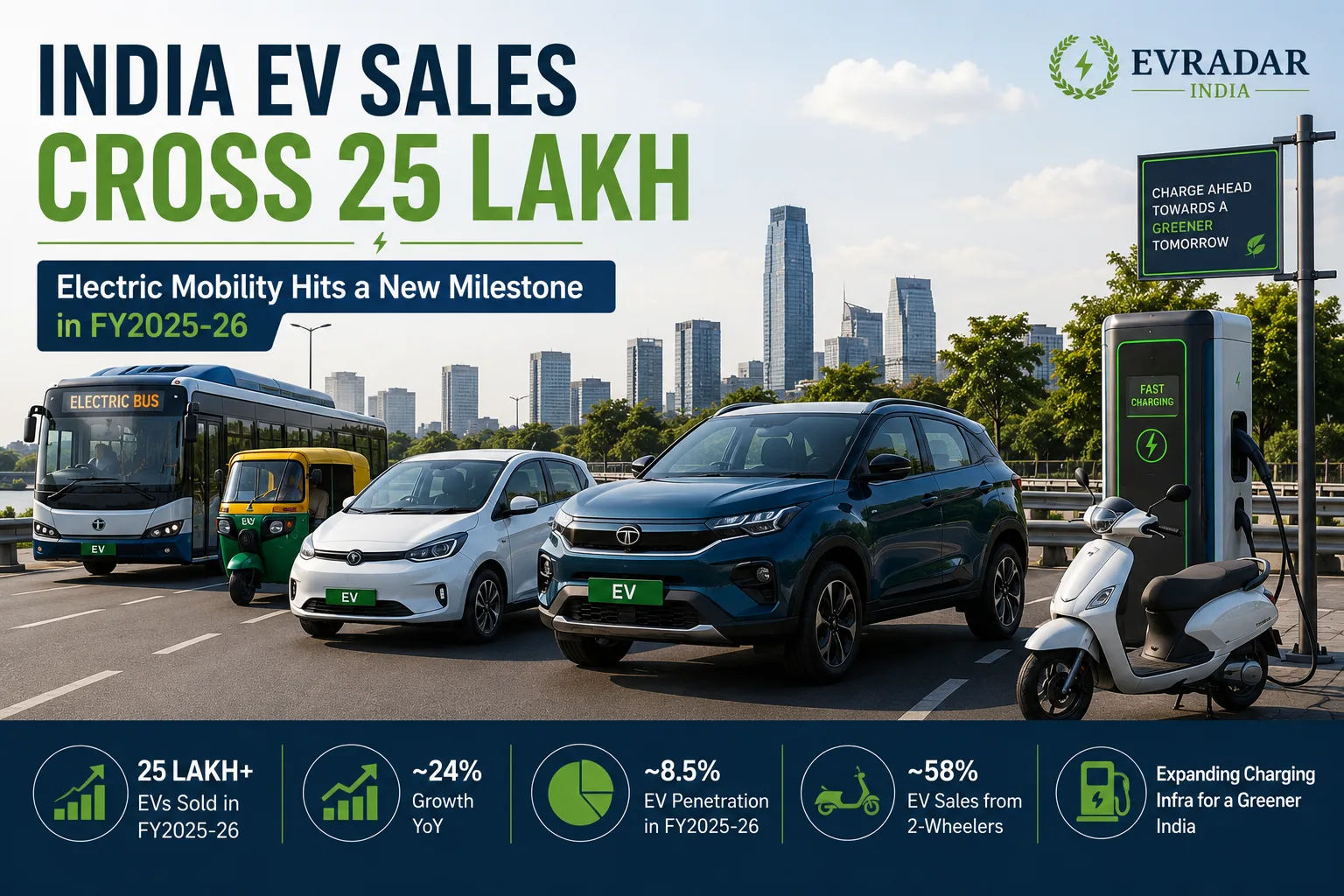
Electric vehicle registrations crossed 25 lakh units during FY2025-26, demonstrating how rapidly EVs are moving from a niche alternative toward a significant part of India's automobile market.
Prime Minister Narendra Modi highlighted the expansion of electric mobility during his Independence Day address on August 15, pointing to the growth of EVs alongside other emerging industries.
Market research also supports the scale of the milestone. JMK Research estimates FY2025-26 EV sales at more than 25 lakh units, representing approximately 24% year-on-year growth, while EV penetration increased to around 8.5% of total vehicle registrations.
From Lakh-Level Sales to a 25-Lakh Market
The long-term transformation of India's electric vehicle industry has been significant.
The Prime Minister contrasted approximately 1.5 lakh electric vehicles in 2009-10 with around 25 lakh in 2025-26, illustrating the dramatic expansion of electric mobility over the period.
At 25 lakh versus 1.5 lakh, the latest figure is roughly 16.7 times as large.
But some of the strongest acceleration has happened much more recently.
Government data shows registered EVs rising from 1.74 lakh in FY2019-20 to 19.68 lakh in FY2024-25.
FY2025-26 then pushed annual registrations beyond the 25-lakh threshold.
India's Recent EV Growth
Financial Year | Registered EVs |
|---|---|
FY2019-20 | 1.74 lakh |
FY2020-21 | 1.43 lakh |
FY2021-22 | 4.59 lakh |
FY2022-23 | 11.83 lakh |
FY2023-24 | 16.81 lakh |
FY2024-25 | 19.68 lakh |
FY2025-26 | 25 lakh+ |
Government Vahan data supports the figures through FY2024-25, while industry analysis puts FY2025-26 registrations above 25 lakh.
Electric Two-Wheelers Remain the Biggest Driver
India's EV transition is very different from markets where electric cars dominate the conversation.
Electric scooters and motorcycles are currently the largest contributors to India's EV volumes.
JMK Research estimates that registered electric two-wheelers represented approximately 57.8% of FY2025-26 EV sales. Passenger electric three-wheelers represented another roughly 29%.
This gives India a particularly interesting EV market.
Instead of electrification beginning primarily with expensive passenger cars, a substantial share of adoption is happening through everyday mobility.
Electric scooters can be attractive for commuters because daily distances are relatively predictable, home charging can be practical and electricity costs can reduce day-to-day running expenses.
Electric Cars Are Growing Faster Too
Electric passenger cars still account for a smaller portion of India's overall EV volumes, but FY2025-26 was an important year for the segment.
Retail passenger EV registrations reached approximately 1.99 lakh units, representing an increase of around 84% year-on-year, according to industry data.
Competition has also intensified.
Established manufacturers are expanding their EV portfolios while new brands are entering the market, giving buyers more choices across compact cars, SUVs and premium electric vehicles.
Increasing competition could eventually improve pricing, technology, charging speeds and ownership experience.
EV Penetration Reaches Around 8.5%
One of the more important numbers isn't simply how many EVs were sold.
It's the percentage of India's total vehicle market that is becoming electric.
EV penetration reached approximately 8.5% in FY2025-26, compared with around 7.7% during the previous financial year.
That means roughly one in every twelve newly registered vehicles was electric.
India still has considerable distance to cover before electric vehicles dominate new vehicle registrations, but the market is clearly moving beyond the experimental stage.
Government Policy Remains an Important Factor
Government programmes have played a major role in developing India's electric mobility ecosystem.
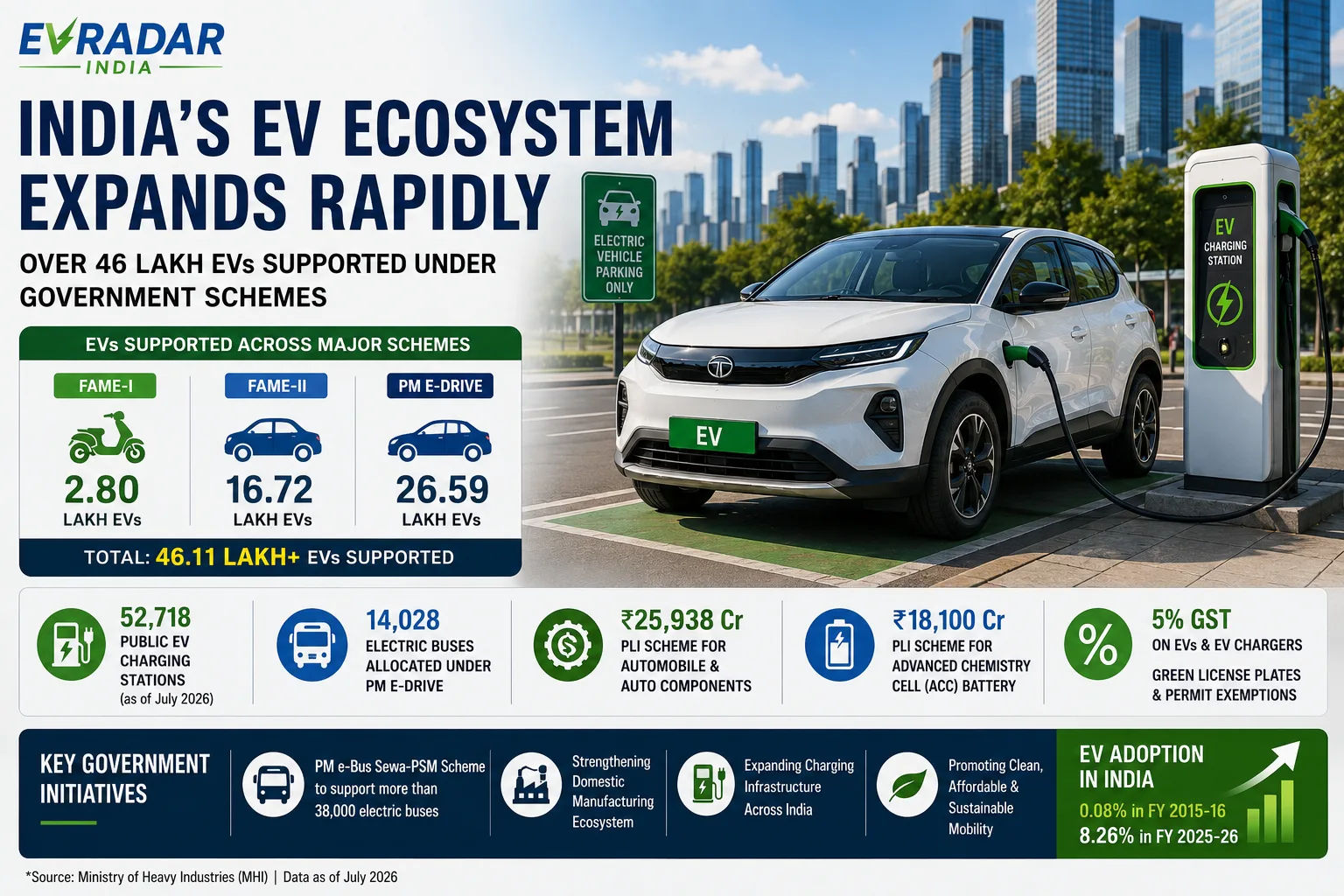
Policies such as FAME-II and PM E-DRIVE have supported vehicle adoption, electric public transport and charging infrastructure.
At the same time, Production Linked Incentive programmes are targeting domestic EV and battery manufacturing.
The broader strategy is increasingly shifting from simply encouraging EV purchases toward building an entire domestic ecosystem around:
Vehicles → Batteries → Components → Charging → Software → Manufacturing → Recycling
This transition could ultimately be more important than vehicle subsidies alone.
The Next Challenge: Charging Infrastructure
Selling millions of electric vehicles creates another requirement: millions of drivers need convenient ways to charge them.
Home charging works well for many electric two-wheeler and passenger-car owners, but public infrastructure becomes increasingly important as EV adoption expands.
Highway charging is particularly critical for electric cars.
The next stage of India's EV growth will therefore depend not only on the number of chargers installed but also on their location, reliability, charging speed, interoperability and uptime.
Battery Manufacturing Could Change the Economics
India also wants to reduce its dependence on imported battery cells and critical EV components.
Domestic cell manufacturing could potentially improve supply-chain resilience and reduce exposure to foreign-exchange movements and international battery prices.
But localization is considerably more complicated than assembling battery packs.
India will need capabilities across cell manufacturing, battery materials, electronics, thermal management, recycling and critical-mineral supply chains.
Building this ecosystem could become one of the most important industrial opportunities created by India's EV transition.
What 25 Lakh EV Sales Mean for India
Crossing 25 lakh annual registrations is more than a headline number.
Every additional EV creates demand across an increasingly large supporting economy.
That includes:
Charging infrastructure
Battery manufacturing
Vehicle servicing
Battery diagnostics
Power electronics
Software and connected vehicles
Fleet management
Financing and insurance
Battery recycling
Renewable-energy integration
Electric mobility is therefore becoming both a transportation transition and an industrial opportunity.
Can India Maintain This Growth?
The trajectory remains positive, but maintaining rapid adoption will require addressing several challenges.
Vehicle affordability remains critical, particularly in the price-sensitive two-wheeler and passenger-car markets.
Consumers also need greater confidence around battery durability, resale value, charging availability and long-term servicing.
Manufacturers, meanwhile, will have to balance larger batteries with affordability rather than competing only on headline range numbers.
EVRadar Take
Crossing 25 lakh EV registrations in a single financial year shows that India's electric mobility market has entered a substantially different phase.
Electric two-wheelers remain the backbone of adoption, while passenger EVs are growing quickly and competition among manufacturers is intensifying.
The next chapter will be less about proving that Indians are willing to buy EVs and more about building the infrastructure required to support them at scale.
Affordable batteries, dependable public charging, domestic manufacturing and strong after-sales networks could determine how quickly EV penetration moves from today's roughly 8.5% toward the next major milestone.
FAQs
1. How many EVs were sold in India in FY2025-26?
India recorded more than 25 lakh electric vehicle registrations during FY2025-26, according to market analysis based on registration data.
2. How much did EV sales grow in FY2025-26?
EV registrations increased approximately 24% year-on-year compared with FY2024-25.
3. What is India's EV penetration rate?
EVs represented approximately 8.5% of total vehicle registrations in FY2025-26, according to JMK Research.
4. Which EV segment sells the most in India?
Electric two-wheelers are India's largest EV category, accounting for approximately 57.8% of FY2025-26 EV sales.
5. How many electric passenger cars were sold?
India recorded approximately 1,99,923 passenger EV registrations in FY2025-26, an increase of around 84% from the previous year.
6. Why are EV sales increasing in India?
More vehicle choices, improving technology, lower operating costs, government programmes, expanding charging infrastructure and greater consumer awareness are contributing to adoption.
7. What is PM E-DRIVE?
PM E-DRIVE is a central government programme supporting India's transition toward electric mobility across eligible vehicle categories and related infrastructure.
8. Are electric two-wheelers important to India's EV market?
Yes. Electric scooters and motorcycles represent the largest portion of India's EV registrations and are central to the country's transition toward electric mobility.
9. What are the biggest challenges for India's EV market?
Key challenges include vehicle affordability, charging availability and reliability, battery costs, resale values, localization and consumer confidence.
10. Will EV sales continue growing in India?
The current trend points toward continued expansion, although future growth will depend on pricing, new vehicle launches, charging infrastructure, policy and battery technology.
Advertisement
Found this helpful?
Share with your friends & EV community