India's EV Sector Attracts ₹2.23 Lakh Crore Investment, But Electricity Still Powers Just 1% of Road Transport
Enjoyed this article?
Advertisement
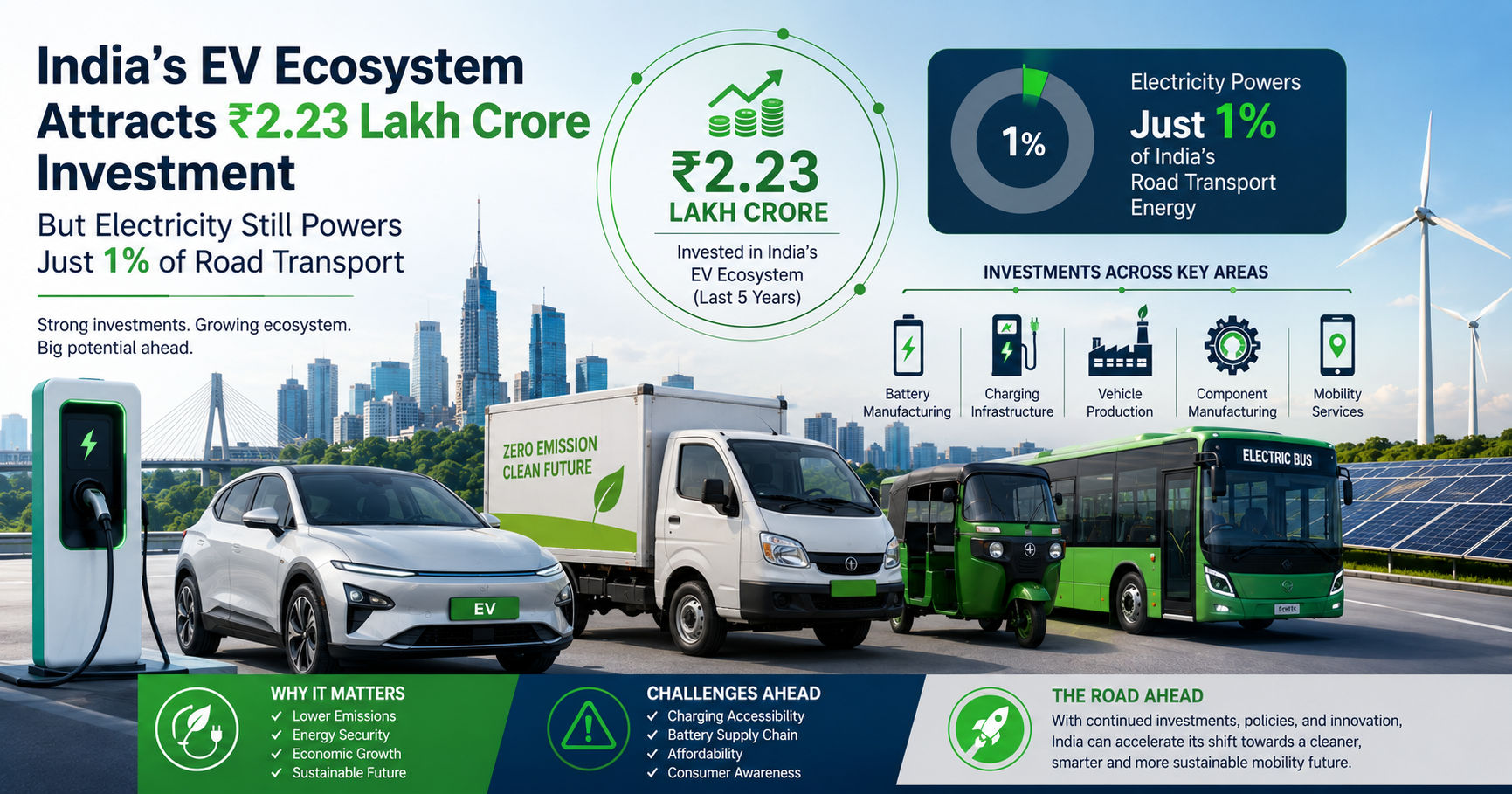
India's electric vehicle (EV) industry has witnessed remarkable investment growth over the past five years, attracting nearly ₹2.23 lakh crore across manufacturing, charging infrastructure, batteries, and mobility services. Despite this progress, electricity continues to account for only around 1% of the country's road transport energy consumption, highlighting the significant challenges that remain in India's transition toward cleaner mobility.
Industry experts believe the next phase of EV growth will require stronger policy support beyond financial incentives, including long-term regulatory measures that encourage wider adoption of zero-emission vehicles.
India's EV Market Continues to Expand
India has emerged as one of the world's fastest-growing electric mobility markets, driven by government incentives, rising fuel prices, and increasing consumer awareness.
Several segments have shown encouraging adoption rates:
Electric three-wheelers continue to lead market penetration.
Electric buses are expanding through government procurement programs.
Passenger EVs and electric two-wheelers are steadily gaining momentum.
Charging infrastructure continues to grow across major cities.
However, fossil fuels continue to dominate India's transport sector, leaving significant room for EV adoption.
Investment Growth Signals Industry Confidence
The EV ecosystem has attracted investments across several key sectors, including:
Battery manufacturing
Charging infrastructure
Vehicle production
Fleet electrification
Component manufacturing
Software and mobility platforms
These investments are helping strengthen India's domestic EV supply chain while supporting the country's long-term sustainability goals.
Why Subsidies Alone May Not Be Enough
Government incentive programs have played an important role in accelerating EV adoption during the early stages of market development.
However, experts believe that subsidies alone may not be sufficient to achieve India's long-term electrification targets.
As financial incentives gradually reduce, policymakers may need to introduce stronger regulatory frameworks that encourage manufacturers to increase the production and sale of zero-emission vehicles.
Commercial EVs Are Leading the Transition
Commercial transportation continues to be one of the strongest growth areas for electric mobility.
High-utilization vehicle segments such as:
Delivery vehicles
Electric buses
Auto-rickshaws
Fleet taxis
offer faster returns on investment due to lower operating costs and predictable daily usage.
This makes commercial fleets an important driver of India's EV ecosystem.
Challenges That Still Need Attention
Despite strong progress, several challenges remain:
Limited charging accessibility in certain regions
High upfront vehicle costs
Battery supply chain development
Financing availability
Consumer awareness
Domestic manufacturing capacity
Addressing these challenges will be essential for accelerating nationwide EV adoption.
Looking Ahead
India has already laid a strong foundation for electric mobility through significant investments and supportive policies.
As the country moves toward its clean mobility goals, industry experts believe future growth will depend on a combination of infrastructure development, domestic manufacturing, supportive regulations, and continued innovation.
With billions already invested in the EV ecosystem, the coming years could determine how quickly India transitions toward a cleaner, more sustainable transportation future.
FAQs
1. How much has India invested in the EV ecosystem?
India's electric vehicle ecosystem has attracted approximately ₹2.23 lakh crore in investments over the past five years across manufacturing, charging infrastructure, batteries, and mobility services.
2. How much of India's road transport energy comes from electricity?
Electricity currently contributes only around 1% of India's road transport energy consumption, although the share continues to grow with increasing EV adoption.
3. Which EV segments are growing the fastest?
Electric three-wheelers, electric buses, commercial delivery vehicles, and fleet mobility services are among the fastest-growing segments in India's EV market.
4. Why is commercial EV adoption increasing?
Commercial EVs offer lower operating costs, reduced maintenance, predictable daily usage, and better long-term savings for fleet operators.
5. What are the biggest challenges facing India's EV industry?
Key challenges include charging infrastructure expansion, battery manufacturing, affordability, financing, domestic supply chains, and consumer awareness.
6. Are government subsidies enough to drive EV adoption?
Subsidies have helped boost early adoption, but experts believe long-term growth will also require stronger infrastructure, supportive regulations, and increased domestic manufacturing.
7. Why are EV investments important for India?
Investments help expand manufacturing capacity, create jobs, strengthen domestic supply chains, improve charging infrastructure, and accelerate the transition to cleaner transportation.
8. What is the future outlook for India's EV market?
With continued investments, policy support, and technological advancements, India is expected to become one of the world's largest electric mobility markets over the coming decade.
Advertisement
Found this helpful?
Share with your friends & EV community