India’s EV Localisation Gains Momentum: Can India Build a Self-Reliant Electric Vehicle Ecosystem by 2030?
Quick Summary
Enjoyed this article?
Advertisement
India's electric vehicle industry is entering a new phase of growth. While the country has already established itself as one of the fastest-growing EV markets globally, the focus is now shifting from simply assembling vehicles to building a complete domestic manufacturing ecosystem.
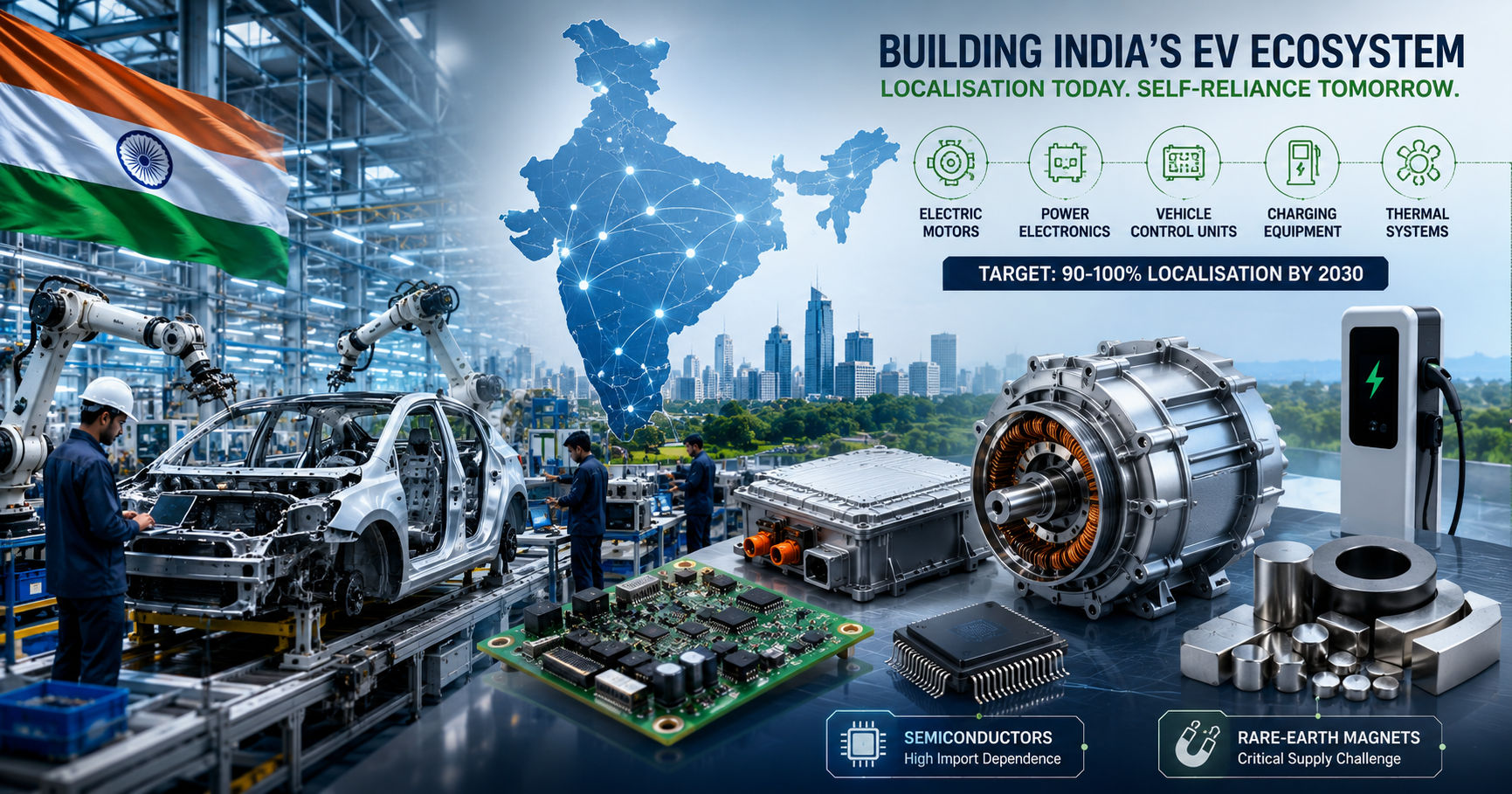
Recent industry research indicates that India could achieve 90% to 100% localisation across several major EV component categories by 2030. This could significantly reduce dependence on imports and strengthen India's position as a global electric mobility hub.
What is EV localisation?
EV localisation refers to manufacturing vehicle components within India instead of importing them from overseas markets.
A highly localised EV ecosystem helps:
Reduce production costs
Strengthen supply chains
Generate employment opportunities
Improve technological capabilities
Decrease import dependence
Localisation is no longer limited to battery packs. Manufacturers are increasingly investing in critical EV systems such as electric motors, power electronics, vehicle control units and charging infrastructure.
Which EV components are seeing strong localisation growth?
India is making significant progress in several component categories.
These include:
Electric Motors
Traction motors are one of the most important parts of an electric vehicle. Domestic production capacity is increasing rapidly as manufacturers expand their operations.
Power Electronics
Power electronics manage energy flow between the battery and motor. Investments in inverters, converters and onboard charging systems are accelerating.
Charging Equipment
Both AC and DC charging infrastructure manufacturing are expanding as EV adoption rises across the country.
Thermal Management Systems
Advanced cooling systems that maintain battery and component temperatures are also becoming a focus area.
Vehicle Control Units
Electronic control systems are increasingly being assembled domestically to support future connected and software-defined vehicles.
The biggest challenge: Semiconductor dependence
Despite strong progress, India still relies heavily on imported semiconductor chips.
Semiconductors are used in:
Battery management systems
Inverters
Vehicle control units
Infotainment systems
Fast charging systems
Building a domestic semiconductor ecosystem will be essential for long-term EV independence.
Rare-earth magnets remain a major concern
Electric motors depend on specialised rare-earth magnets.
Global supply chains are currently concentrated in a few countries, making supply vulnerable to geopolitical disruptions and price fluctuations.
Developing domestic processing capabilities will become increasingly important over the next decade.
Localisation does not always mean domestic value creation
There is an important difference between assembling components in India and creating value entirely within the country.
For example, an electric motor assembled in India may still rely on imported magnets, semiconductor chips and specialised materials.
True value creation will happen only when upstream industries also develop locally.
What needs to happen next?
To accelerate EV localisation, India must focus on:
Expanding semiconductor manufacturing
Building rare-earth processing capabilities
Supporting EV startups
Encouraging component standardisation
Investing in research and development
Strengthening domestic supplier networks
Outlook for 2030
India's EV industry has grown rapidly over the past few years and is now entering a more mature phase.
If current investments continue, the country could emerge as a major global EV manufacturing hub by 2030.
The future of India's EV industry will not depend solely on battery production. Success will be determined by how effectively India develops complete supply chains for electronics, advanced materials, software and critical components.
The journey toward a self-reliant EV ecosystem has begun, but deeper value creation will require sustained investment, innovation and policy support.
Source inspiration: Industry analysis and publicly available research. This article has been independently written and rewritten for informational purposes.
FAQs
1. What is EV localisation?
EV localisation refers to manufacturing electric vehicle components within India instead of importing them from other countries. It helps reduce costs, strengthen supply chains and create jobs.
2. Can India achieve 100% EV localisation by 2030?
Industry reports suggest several non-battery EV component categories could achieve 90-100% localisation by 2030 if announced manufacturing projects are successfully completed.
3. Which EV components are being localised in India?
India is increasing domestic manufacturing of:
Electric motors
Power electronics
Vehicle control units
Charging equipment
Thermal management systems
Wiring harnesses
Braking systems
Suspension systems
4. Why are semiconductors important for EVs?
Semiconductors control essential vehicle functions such as battery management, motor operation, infotainment systems, charging systems and electronic control units.
5. Why are rare-earth magnets important in electric vehicles?
Rare-earth magnets are used inside permanent magnet electric motors, which are widely used because of their high efficiency and performance.
6. What is the biggest challenge for India's EV manufacturing ecosystem?
The biggest challenge is reducing dependence on imported semiconductor chips, rare-earth magnets and specialised raw materials.
7. What is the difference between localisation and domestic value creation?
Localisation means assembling products within India, while domestic value creation means manufacturing most of the raw materials, technologies and components locally.
8. How does EV localisation benefit India?
EV localisation can:
Reduce import dependency
Create employment opportunities
Lower manufacturing costs
Strengthen domestic supply chains
Improve technological capabilities
Increase exports in the future
Advertisement
Found this helpful?
Share with your friends & EV community