India EV Sales Could Reach 30.4 Million Units by 2032, Says Industry Forecast
Quick Summary
India's electric vehicle market is expected to witness unprecedented growth, with annual EV sales potentially crossing 30 million units by 2032. Rising consumer adoption, battery demand, charging infrastructure expansion, and local manufacturing investments are expected to drive the next phase of el
Enjoyed this article?
Advertisement
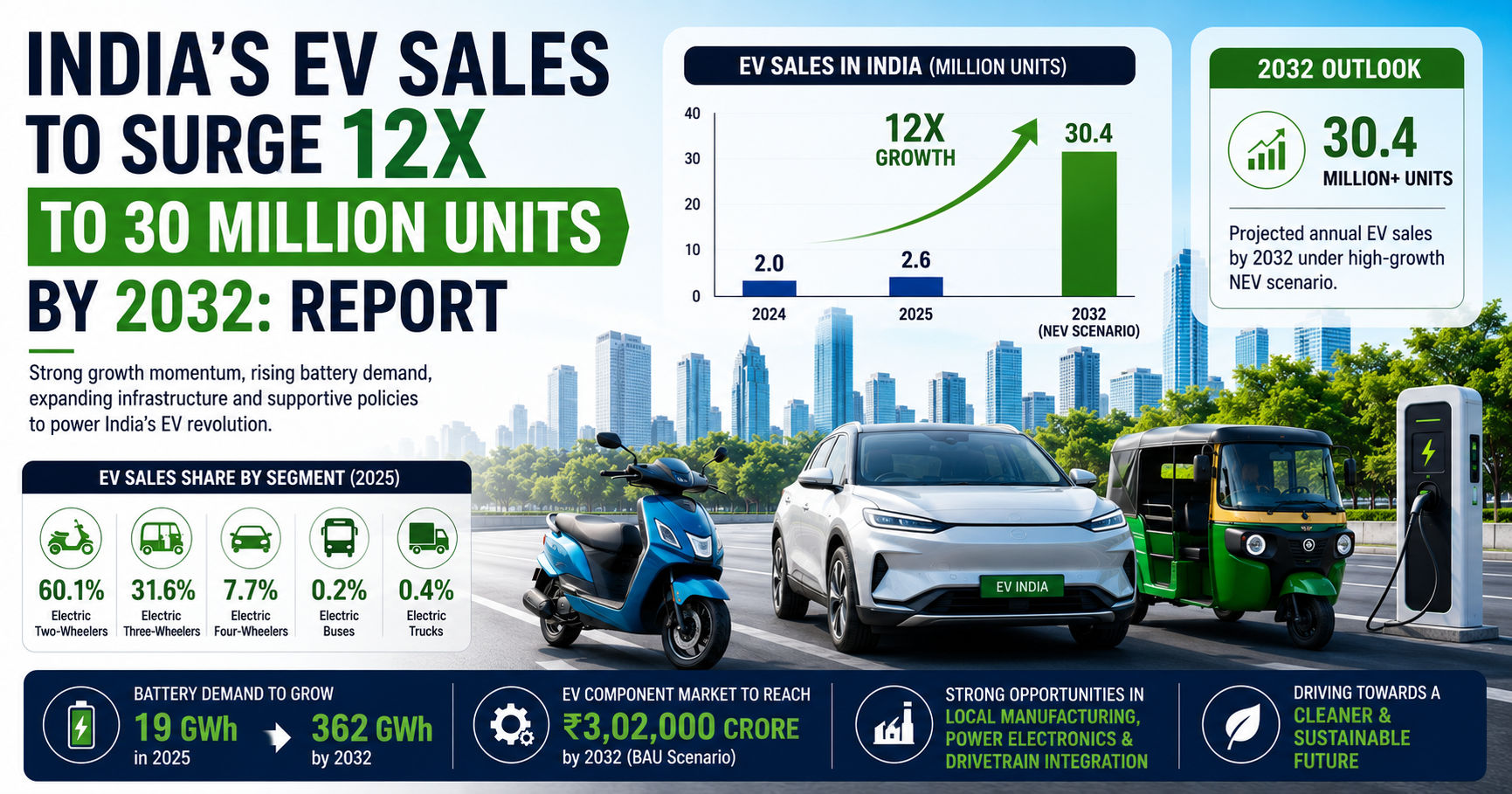
India's electric vehicle (EV) industry is entering a period of rapid expansion, with new industry projections indicating annual EV sales could exceed 30 million units by 2032 under an accelerated growth scenario.
The forecast highlights the growing momentum of electric mobility across India, supported by increasing consumer demand, rising fuel prices, expanding charging infrastructure, technological advancements, and stronger domestic manufacturing capabilities.
EV Market Continues Strong Growth
India's EV sector has demonstrated significant progress in recent years. Annual electric vehicle sales increased from approximately 2 million units in 2024 to around 2.6 million units in 2025, representing strong year-over-year growth.
The share of electric vehicles within the overall automotive market has also expanded, reflecting growing acceptance of EV technology among Indian consumers.
EV Sales Growth Snapshot
Year | EV Sales |
|---|---|
2024 | 2.0 Million Units |
2025 | 2.6 Million Units |
2032 Forecast | 30.4 Million Units |
This growth is being driven by several factors, including lower operating costs, improved vehicle options, and increasing awareness of sustainable transportation.
Electric Two-Wheelers Continue to Lead
Electric two-wheelers remain the backbone of India's EV ecosystem and account for the majority of electric vehicle sales.
EV Sales Distribution (2025)
Segment | Market Share |
|---|---|
Electric Two-Wheelers | 60.1% |
Electric Three-Wheelers | 31.6% |
Electric Four-Wheelers | 7.7% |
Electric Buses | 0.2% |
Electric Trucks | 0.4% |
Electric scooters and motorcycles continue to attract urban commuters due to their affordability and low running costs.
Meanwhile, electric three-wheelers remain an important part of last-mile mobility and commercial transportation.
Passenger EV Adoption Accelerating
The electric passenger vehicle segment is experiencing faster growth as automakers launch new electric SUVs and cars with improved range, technology, and charging capabilities.
Consumers are increasingly considering EVs as practical alternatives to conventional vehicles, particularly in metropolitan areas where charging infrastructure continues to improve.
Battery Demand Expected to Rise Significantly
One of the most important indicators of EV market growth is battery demand.
Industry projections suggest battery demand could increase dramatically over the coming years as both EV volumes and battery capacities continue to grow.
Battery Demand Outlook
Year | Battery Demand |
|---|---|
2024 | 13 GWh |
2025 | 19 GWh |
2032 Forecast | 362 GWh |
This growth reflects increasing adoption across passenger vehicles, commercial vehicles, and public transportation fleets.
Battery Consumption by Vehicle Category (2025)
Segment | Share |
|---|---|
Electric Four-Wheelers | 40% |
Electric Three-Wheelers | 27% |
Electric Two-Wheelers | 23% |
Electric Buses | 7.8% |
Electric Trucks | 1.9% |
Electric buses account for a significant share of battery demand despite relatively low sales volumes because they require substantially larger battery packs.
India's EV Component Industry Set for Expansion
The growth of EV adoption is expected to create major opportunities across India's automotive supply chain.
The domestic EV component market is projected to expand rapidly as demand increases for batteries, motors, power electronics, and vehicle control systems.
EV Component Market Breakdown (2025)
Component | Share |
|---|---|
Battery Packs | 52% |
Motors | 22% |
Inverters | 12% |
Battery Management Systems | 11% |
DC-DC Converters | 3% |
Battery packs currently represent the largest share of the EV component ecosystem, highlighting the importance of local battery manufacturing and supply chain development.
Localization Remains a Key Challenge
While India has made significant progress in EV manufacturing, several critical components still rely heavily on imports.
Industry experts believe increased localization of:
Motors
Controllers
Inverters
Battery Management Systems
Power Electronics
will be essential for reducing costs, strengthening supply chains, and improving India's competitiveness in the global EV market.
Key Drivers Behind India's EV Growth
Several factors are expected to support long-term EV adoption:
✅ Rising fuel prices
✅ Expanding charging infrastructure
✅ Increasing EV model availability
✅ Government policy support
✅ Growing domestic manufacturing investments
✅ Improvements in battery technology
✅ Greater consumer awareness of sustainable mobility
Outlook for India's EV Industry
India is on track to become one of the world's most significant electric mobility markets during the next decade.
If infrastructure development, policy support, and local manufacturing continue to advance, electric vehicles could transform the country's transportation sector while creating substantial opportunities for manufacturers, suppliers, charging operators, and technology providers.
The coming years will be critical in determining how quickly India can achieve its electrification ambitions and strengthen its position in the global EV ecosystem.
FAQs
How many EVs could India sell by 2032?
Industry forecasts suggest annual EV sales could reach approximately 30.4 million units by 2032 under a high-growth scenario.
Which EV segment dominates India's market?
Electric two-wheelers currently lead the market, accounting for more than 60% of total EV sales.
Why is battery demand increasing?
Growing EV adoption and larger battery pack sizes are driving higher battery demand across vehicle categories.
What is the future of electric cars in India?
Electric passenger vehicles are expected to witness strong growth as more manufacturers launch new EV models and charging infrastructure expands.
How large could India's EV component market become?
The domestic EV component industry is expected to grow significantly over the coming years, creating opportunities across batteries, motors, power electronics, and vehicle systems.
Advertisement
Found this helpful?
Share with your friends & EV community