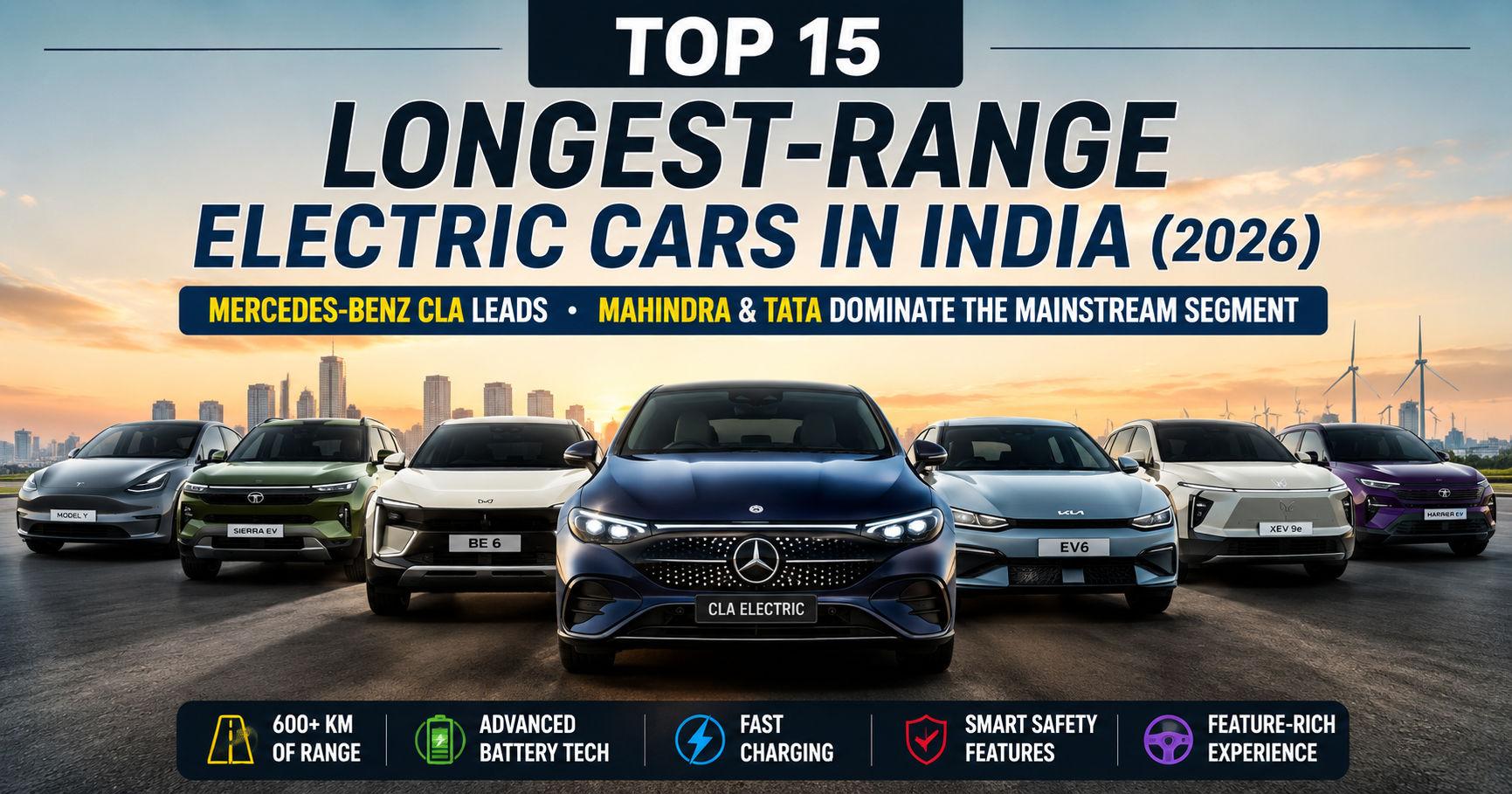
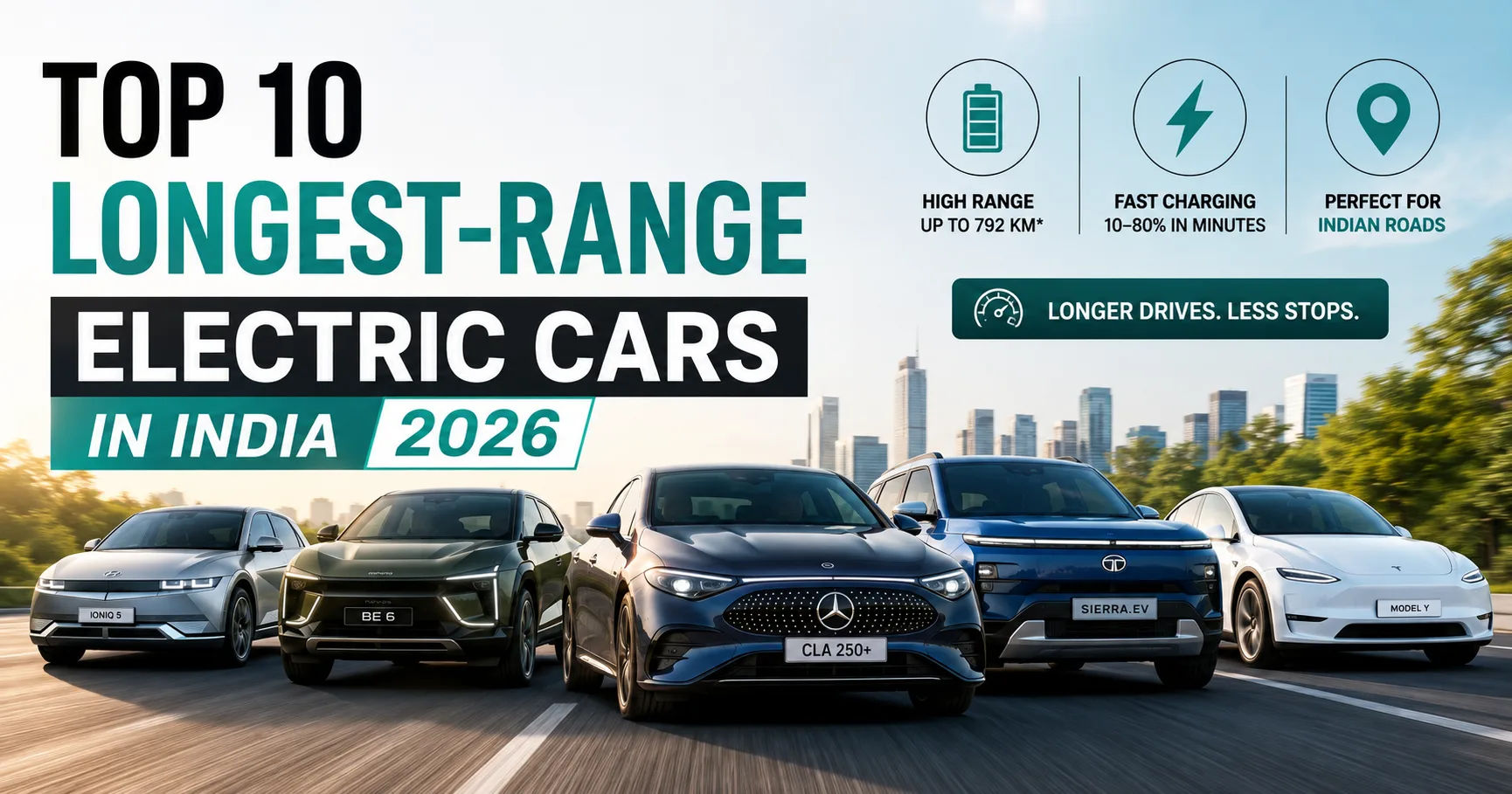
Top 15 Longest-Range Electric Cars in India (2026)
Driving range remains one of the biggest considerations for buyers planning to switch to an electric vehicle. While India's charging infrastructure continues to grow, a longer driving range provides greater flexibility for daily commuting as well as intercity travel.
The Indian EV market has evolved significantly in 2026, with several manufacturers now offering electric cars capable of travelling well beyond 600 km on a single charge under certified testing conditions. Luxury brands continue to set new benchmarks, while homegrown manufacturers like Mahindra and Tata Motors have introduced competitive long-range electric SUVs at much more accessible price points.
Here's a look at the 15 longest-range electric cars currently available in India.
Rank | Model | Claimed Range | Test Cycle | Starting Price |
|---|
1 | Mercedes-Benz CLA Electric | 792 km | WLTP | ₹55–59 lakh* |
2 | Mahindra BE 6 | 682 km | ARAI | ₹23.50 lakh |
3 | Tesla Model Y Long Range | 681 km | WLTP | ₹61.99 lakh |
4 | Mercedes-Benz EQS 580 | 677 km | WLTP | ₹1.30 crore |
5 | Tata Sierra EV | 665 km | MIDC | ₹18.79 lakh |
6 | Kia EV6 | 663 km | ARAI | ₹65.90 lakh |
7 | Mahindra XEV 9e | 656 km | ARAI | ₹26.50 lakh |
8 | BYD Seal | 650 km | NEDC | ₹43–56 lakh |
9 | BMW iX xDrive50 | 635 km | WLTP | ₹1.40 crore |
10 | Hyundai Ioniq 5 | 631 km | ARAI | ₹46 lakh |
11 | Tata Harrier EV | 627 km | MIDC | ₹21.50 lakh |
12 | Kia Carens Clavis EV | 530 km | MIDC | ₹18.50 lakh |
13 | Kia Syros EV | 526 km | MIDC | ₹13.49 lakh |
14 | Hyundai Creta Electric | 510 km | ARAI | ₹18 lakh |
15 | MG Windsor EV Pro | 449 km | MIDC | ₹17.50 lakh |
*Indicative introductory pricing where applicable.
Mercedes-Benz Raises the Benchmark
The Mercedes-Benz CLA Electric currently offers the highest claimed driving range among electric cars on sale in India. With a WLTP-certified range of 792 km, it showcases the latest advances in battery efficiency, aerodynamics, and energy management, making it one of the most capable premium EVs available.
Mahindra Leads the Mainstream EV Space
Mahindra has rapidly emerged as a leader in India's mass-market electric vehicle segment.
The Mahindra BE 6 delivers an impressive 682 km (ARAI) claimed range, making it one of the longest-range electric SUVs in its price category. Close behind is the Mahindra XEV 9e, which offers 656 km, supported by the company's dedicated INGLO EV platform, modern battery technology, and advanced connected features.
Tata Motors Continues Its EV Expansion
Tata Motors has strengthened its premium electric SUV portfolio with models capable of covering long distances.
The Tata Sierra EV offers a claimed 665 km range, while the Tata Harrier EV delivers 627 km, giving buyers more options in the growing long-range SUV segment.
Kia Builds a Diverse EV Portfolio
Kia now offers multiple electric vehicles catering to different customer needs.
The Kia EV6 continues to be one of India's longest-range premium EVs with 663 km of certified range. Meanwhile, the Kia Carens Clavis EV and Kia Syros EV target family and compact SUV buyers by combining practical driving range with modern technology and fast-charging capability.
Premium Electric Cars Continue to Impress
Global manufacturers are also expanding India's premium EV landscape.
Models such as the Tesla Model Y Long Range, Mercedes-Benz EQS, BMW iX xDrive50, BYD Seal, and Hyundai Ioniq 5 all offer certified driving ranges exceeding 600 km, making them attractive choices for customers seeking luxury, technology, and long-distance capability.
Understanding EV Range Ratings
When comparing electric vehicles, it's important to understand that different manufacturers use different certification standards.
WLTP – Widely regarded as one of the most realistic global testing standards.
ARAI – India's official certification process.
MIDC – Commonly used by Indian EV manufacturers.
NEDC – An older international standard that generally reports higher range figures.
Real-world driving range is usually lower than certified values because of factors such as traffic, driving style, weather conditions, terrain, passenger load, and air-conditioning usage.
Final Thoughts
Electric vehicle technology has advanced rapidly, making long-distance travel more practical than ever before. Today, buyers no longer need to spend over ₹1 crore to own an EV capable of travelling more than 600 km on a single charge.
With manufacturers such as Mahindra, Tata Motors, Kia, Hyundai, Mercedes-Benz, Tesla, BMW, and BYD introducing increasingly capable electric vehicles, Indian consumers now have a wider selection of long-range EVs across multiple price segments.
As battery technology continues to improve and the country's charging infrastructure expands, future competition is expected to focus not only on range but also on charging speed, software, battery durability, and the overall ownership experience.
FAQS
1. Which electric car has the longest driving range in India in 2026?
The Mercedes-Benz CLA Electric currently offers the highest claimed driving range in India with up to 792 km (WLTP-certified), making it the longest-range electric car on sale.
2. Which is the longest-range affordable electric car in India?
Among mainstream EVs, the Mahindra BE 6 leads with a claimed 682 km (ARAI) range, followed closely by the Tata Sierra EV and Mahindra XEV 9e.
3. Which Indian electric cars offer more than 600 km of range?
Several Indian-made EVs now exceed 600 km of claimed range, including:
Mahindra BE 6
Mahindra XEV 9e
Tata Sierra EV
Tata Harrier EV
4. Is the Tesla Model Y available in India?
Yes. The Tesla Model Y Long Range is available in India and offers a claimed 681 km WLTP-certified driving range, placing it among the country's longest-range EVs.
5. Which Kia electric car offers the highest range in India?
The Kia EV6 offers the highest claimed range in Kia's Indian lineup at 663 km (ARAI), followed by the Kia Carens Clavis EV and Kia Syros EV.
6. What is the difference between WLTP, ARAI, MIDC, and NEDC range figures?
WLTP – More representative of real-world driving.
ARAI – India's official certification standard.
MIDC – Testing cycle commonly used for Indian EVs.
NEDC – Older international testing standard that generally reports higher range figures.
7. Does a higher claimed range mean the same real-world range?
No. Actual driving range depends on several factors including:
Driving style
Traffic conditions
Road terrain
Weather
Air conditioning usage
Vehicle load
Real-world range is generally 15–30% lower than certified figures.
8. Which electric SUV offers the best driving range in India?
Some of the highest-range electric SUVs include:
Mahindra BE 6
Tata Sierra EV
Kia EV6
Mahindra XEV 9e
Tata Harrier EV
9. Are long-range electric cars suitable for highway travel?
Yes. Most EVs offering over 600 km of certified range are designed for both city commuting and long-distance highway journeys, especially when supported by fast-charging infrastructure.
10. What should buyers consider besides driving range when choosing an EV?
Apart from range, buyers should also evaluate: